Chess variants for four players. They play in two teams: Yellow and Red play against Green and Blue. The teammates support each other, and attack the other team together.
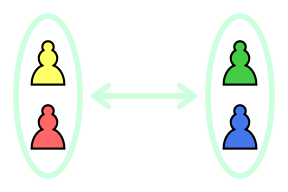
The game ends when someone gets checkmated. Then the checkmater team wins and the other team loses.
More detailed rules: Four-player chess. These variants differ only in the board and the movement of the pieces. The general rules are the same.
Back to the categories
"Cut!" a voice in the classroom yelled. It wasn't Brian this time; it was the VCR. The tape was old, and the tracking was off. The screen rolled vertically for ten seconds before stabilizing.
Educators addressed the internal and external mechanics of the male reproductive system to alleviate anxiety regarding involuntary bodily functions:
Providing shared educational experiences for all young people fosters a community of mutual understanding.
The film aimed to educate preteens entering puberty about sexual development. Its most notable and controversial feature was its use of . The film portrayed: The screen rolled vertically for ten seconds before
The documentary opens with a simple but effective premise: it introduces viewers to two babies, highlighting the anatomical differences between male and female genitals. From this foundational starting point, the film proceeds through puberty’s physical transformations, showing how reproductive organs change as boys and girls mature. Unlike many contemporaneous sex‑education films that relied on drawings or diagrams, Puberty: Sexual Education for Boys and Girls employs abundant nudity, presenting the human body without embarrassment or euphemism.
One of the most progressive elements of this 1991 update was its commitment to inclusivity and shared understanding. While many previous programs separated boys and girls for "the talk," this curriculum advocated for certain shared lessons. The goal was to build empathy; by learning about the experiences of the opposite gender, students could develop greater respect and support for one another. This approach helped dismantle harmful stereotypes and laid the groundwork for more equitable relationships in the future.
This public link is valid for 7 days and shares a thread, including any personal information you added. This link or copies made by others cannot be deleted. If you share with third parties, their policies apply. Can’t copy the link right now. Try again later. Its most notable and controversial feature was its use of
When puberty hits, the brain’s limbic system (the emotional center) accelerates long before the prefrontal cortex (the logic center) catches up. This creates a "perfect storm" where romantic interests feel incredibly intense, yet the tools to manage those feelings are still underdeveloped. Education that focuses solely on anatomy fails to address the "why" behind these new urges. By discussing the emotional landscape—infatuation, rejection, and the thrill of a first crush—educators can normalize these experiences, reducing the shame or confusion that often accompanies them. Scripting Healthy Storylines
Below is a structured paper outline and core content that explores how educators can integrate these vital themes into standard puberty curricula. 📑 Paper Title: Beyond Biology
While the 1991 framework focused heavily on anatomy, modern updates emphasize the psychological aspects of maturing. Mood Fluctuations Key milestones taught included:
Respect and consent are essential in any relationship. Consent means saying yes freely and clearly—no means no. If you feel pressured or unsafe, tell a trusted adult or contact a health professional. To prevent pregnancy and STIs, condoms are effective and available—talk to a doctor or clinic for full options.
Lessons detailed the role of the pituitary gland in releasing follicle-stimulating hormone (FSH) and luteinizing hormone (LH), which stimulate the ovaries to produce estrogen. Key milestones taught included: